How to Replace IVR with a Conversational AI Voice Agent (2025 UK Migration Guide)
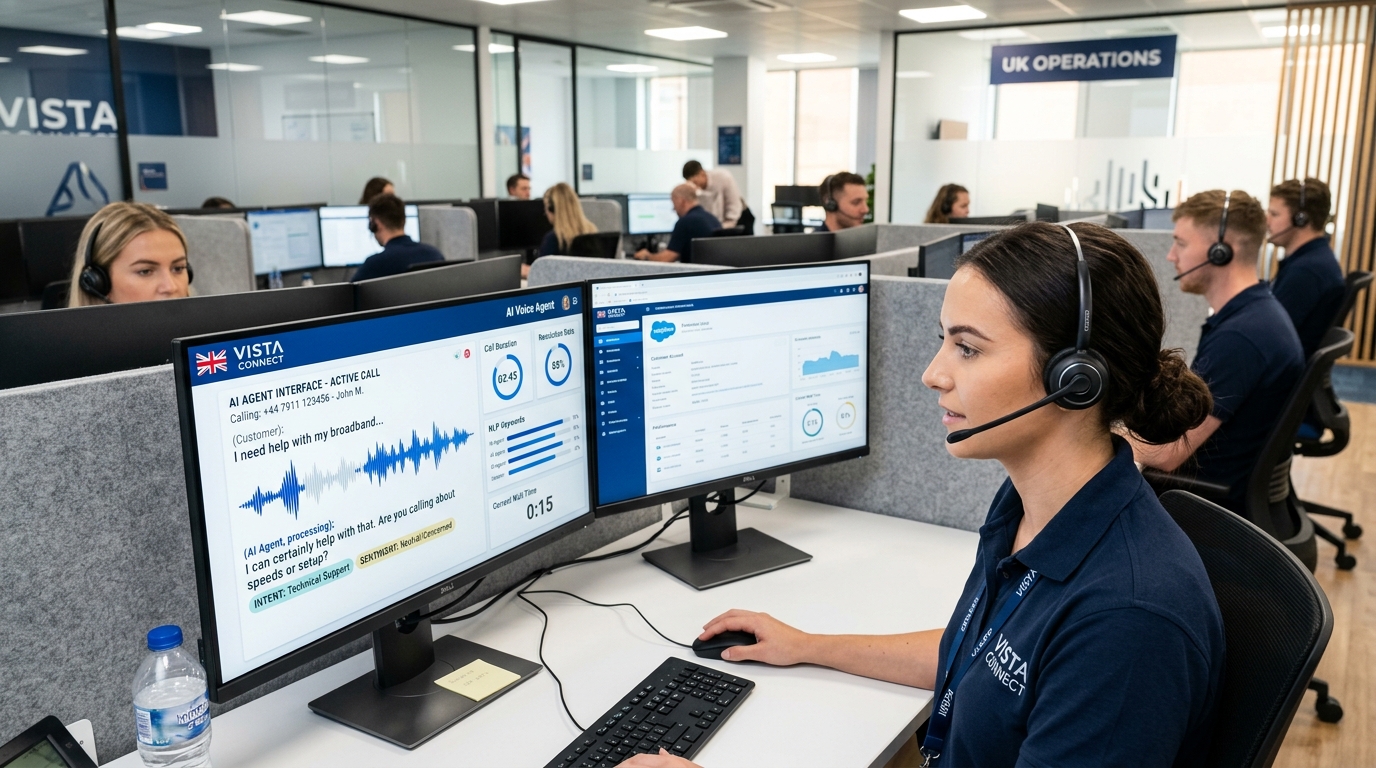
Replacing IVR with a conversational AI voice agent means auditing your existing menu tree, deploying a natural language understanding (NLU) voice agent that interprets caller intent through dialogue rather than button presses, and maintaining fallback routing to human agents when needed. UK contact centres making this shift report containment rate improvements from 15-30% (traditional IVR) to 70-80% (AI voice agents), with cost-per-call reductions of 85-95%.
Why Traditional IVR Systems Are Failing UK Contact Centres
Traditional IVR systems force callers into rigid menu structures that drive abandonment and frustration. Recent industry data shows UK call centre abandonment rates have climbed from 5.4% in 2018 to 8.9% in 2024, with IVR-specific abandonment averaging 15% across industries. Mobile operators and utilities—sectors that rely heavily on IVR—see significantly higher rates, as callers simply hang up when forced through multi-level menus.
The problem isn't just user experience. Every abandoned call represents lost revenue, repeat contact costs, and damaged customer relationships. Meanwhile, conversational AI voice agents handle the same volume with 70-80% containment rates, meaning seven or eight out of ten callers get their issue resolved without needing a human agent.
For UK businesses, the pressure is mounting from multiple directions: Consumer Duty obligations require demonstrable fair treatment, customers increasingly expect Amazon Alexa-style natural interactions, and cost-per-contact continues rising as recruitment and training costs climb.
Traditional IVR vs Conversational AI Voice Agent vs Hostcomm Persona AI
| Metric | Traditional IVR | Conversational AI Voice Agent | Hostcomm Persona AI |
|---|---|---|---|
| Containment Rate | 15-30% | 40-60% | 70-80% |
| Setup Time | 8-12 weeks | 6-8 weeks | 2-4 weeks (native Contact-Pro integration) |
| Cost Per Call | £4.50-£9.00 (incl. escalation) | £1.50-£3.50 | £0.25-£0.40 (automated) |
| CRM/Dialler Integration | High effort (custom telephony work) | Medium (API + training required) | Low (built on Contact-Pro dialler) |
| Languages Supported | 2-3 (recorded prompts) | 10-15 (TTS-based) | 40+ (real-time multilingual NLP) |
| UK Data Hosting | Varies by vendor | Varies by vendor | Native UK hosting (GDPR compliant) |
| Ofcom Call Handling Compliance | Manual audit required | Partial (depends on vendor) | Built-in audit trail + compliance logging |
How to Migrate from IVR to AI Voice Agent Without Losing Call Routing Control
This six-step migration framework is used by UK contact centres to replace IVR systems without service disruption. The entire process typically runs 8-12 weeks from audit to full deployment.
Step 1: Audit Your Existing IVR Call Flows
Map every menu option, call path, and escalation point in your current IVR. Most legacy systems have 8-15 menu levels with dozens of dead-end paths—routes that force callers to hang up or start over. Document:
- Call volume by menu option (which paths handle the most traffic?)
- Abandonment points (where do callers give up?)
- Average time in IVR before reaching an agent
- Percentage of calls that loop back or require multiple attempts
If your telephony platform exports call logs, analyse 30 days of data. If not, manually track 200-300 calls to identify the 20% of call reasons driving 80% of volume—these are your automation candidates.
Step 2: Map IVR Menu Paths to Natural Language Intents
Convert menu-driven logic into natural language intents. For example, the IVR path "Press 1 for orders, then press 2 for order status" becomes the intent "Check my order status" with variations like "Where's my delivery?", "Track my parcel", "Order hasn't arrived".
Start with 15-20 core intents covering your highest-volume call reasons. Hostcomm Persona AI's intent library includes pre-built UK contact centre intents (billing inquiries, appointment booking, service faults, account updates) that you can adapt rather than build from scratch.
For each intent, define: required data points (order number, account ID, postcode), backend system lookup (CRM, order management, billing platform), and success criteria (what does "resolved" look like?).
Step 3: Integrate SIP Trunks and ACD with Your AI Voice Platform
This is where most generic voice AI deployments stall. You need Session Initiation Protocol (SIP) trunk connectivity to your telephony carrier, Automatic Call Distribution (ACD) rules to route calls intelligently, and real-time CTI (Computer Telephony Integration) links to your CRM.
Hostcomm's Contact-Pro predictive dialler already handles these integrations. The AI voice agent (Persona) sits in front of Contact-Pro, managing inbound calls and routing unresolved interactions to the right human agent with full context—caller history, intent confidence score, and conversation transcript.
Technical integration checklist:
- API access to your CRM (Salesforce, Microsoft Dynamics, Zendesk, Freshservice, HubSpot)
- Real-time data lookup (sub-200ms response time for caller authentication)
- Call recording and compliance logging (required for FCA, PCI-DSS, Ofcom)
- Warm transfer protocol (AI passes conversation history to agent)
Most UK deployments with Hostcomm take 2-3 weeks for full integration, including testing and compliance sign-off.
Step 4: Run Parallel Deployment with DTMF Fallback
Never hard-swap the AI agent for the legacy IVR on day one. Run dual-mode for 4-6 weeks: the system captures both speech and DTMF (touch-tone) input simultaneously. Speech is primary; DTMF is fallback. Callers who say "press 1" habitually still get routed; callers who speak naturally get the AI path.
Ramp the AI path gradually: Week 1 at 10% of inbound calls, Week 2 at 25%, Week 3 at 50%, Week 4 at 75%, Week 5 at 100% AI primary with DTMF fallback. This ramp gives you four weeks of production data to find edge cases the testing phase missed.
Step 5: Configure Fallback Routing and Escalation Rules
Even the best AI voice agent will encounter calls it cannot resolve. Define clear escalation rules:
- Intent confidence threshold: below 60% confidence, route to human agent
- Sentiment triggers: if caller frustration detected, immediate escalation
- Compliance-required paths: some interactions legally require human oversight (vulnerable customer contacts, debt collection regulated under CONC)
- Time-based fallback: if call duration exceeds 4 minutes without resolution, offer human transfer
When escalation happens, the human agent should receive the full conversation context—not force the caller to repeat themselves. Hostcomm Persona AI passes conversation transcript, detected intent, and CRM data directly to the Contact-Pro agent desktop.
Step 6: Monitor Containment Rate, Average Handle Time, and CSAT
Track three KPIs rigorously in the first 90 days:
- Containment rate: Percentage of calls resolved by the AI without human intervention (target: 70-80%)
- Average Handle Time (AHT): Should drop 35-45% as AI handles routine queries and pre-loads context for escalations
- Customer Satisfaction (CSAT): Post-call surveys—watch for drop-off in the first 2 weeks as callers adjust, then recovery by week 4
One UK utility provider using Hostcomm Persona AI reported a 43% reduction in AHT within 6 weeks of full deployment, driven primarily by the AI handling meter reading submissions (previously 4 minutes average, now 47 seconds end-to-end) and pre-loading account context for escalated calls.
Subscribe to newsletter
Want to learn more about how we can help your business grow?
Related Articles
Delve into a rich tapestry of knowledge and inspiration in our blog section. Unleash the potential of your coding journey as we explore industry trends.