The 6 Must-Have Features for a UK Dialler in 2026 (AMD, Caller ID Health, Hiya Registration & More)
Choosing a UK outbound dialler in 2026 means getting six things right: low-failure-rate answering machine detection (AMD), call screener management, easy DID ordering and deployment, caller ID health analysis and alerting, calling behaviour pattern management (rotation, localisation, avoiding overcalling), and registration with Hiya and Truecaller. This guide covers each one with the UK rules that apply — Ofcom, PECR and TPS — and the questions to ask any vendor.
Why These Six Features Matter Now
Call screeners on smartphones have become gatekeepers. Networks and apps label numbers based on calling behaviour and user reports, not intent. A dialler set up the way it was in 2020 will struggle in 2026 without these six capabilities working together.
Ofcom’s persistent misuse policy still caps abandoned calls at 3% of live calls per campaign over any 24-hour period, and that figure must include a reasoned estimate of AMD false positives. Since 5 February 2026, the Data (Use and Access) Act 2025 has raised the maximum fine under PECR to £17.5 million or 4% of global turnover, putting real money behind TPS screening failures and nuisance calling. Meanwhile, Hiya’s spam labelling and caller identification now run on BT and EE (since 2023), Virgin Media O2 (since 2024) and Samsung Galaxy phones, so many of the people you call see a Hiya verdict before they decide whether to answer.
1. Low-Failure-Rate AMD (Answering Machine Detection)
Ofcom counts an AMD false positive — a real person mistaken for an answering machine and disconnected — as an abandoned call. Every AMD user is expected to hold a reasoned estimate of its false-positive rate and include it in the abandoned-call figure. If even a few per cent of the people who answer are wrongly cut off, a 10,000-call campaign produces hundreds of silent calls, and most of your 3% headroom is gone before anything else is counted.
Contact-Pro detects answering machines and call screeners on predictive campaigns and holds each campaign to the 3% abandoned-call limit per UK day, with AMD false positives counted in.
Ask any vendor for their reasoned estimate of AMD false positives and how it was measured. If they can’t provide it with supporting data, assume their detection hasn’t kept pace.
2. Call Screener Management
Call screening — Apple’s Call Screening and Live Voicemail, Google’s Call Screen and network-level labelling — now asks unknown callers who they are and why they’re calling before the phone rings through, or sends them straight to voicemail.
Managing screeners means two things. First, never leave silence: Ofcom expects a brief information message to play if a call is answered and no agent is available within two seconds, and a screener that hears dead air will treat the call as junk. Second, the dialler has to recognise a screener as something different from a person or a voicemail, so the call is answered properly rather than dropped.
Contact-Pro treats call screeners as their own outcome rather than as an answering machine, and plays an information message when a call is answered with no agent free. Contacts that screen repeatedly can be worked in preview mode, so an agent decides when and how to call.
3. DID Easy Ordering and Deployment
You need multiple DIDs — Direct Inward Dial numbers — for rotation, localisation and separating campaigns. If getting new numbers means a separate telecoms order, a wait and manual configuration, campaigns go out on tired numbers because replacing them is too much effort.
When you assess a dialler, ask: how long from order to a live number? Can I choose the area code? Can a campaign manager assign numbers to campaigns, or does it need an engineer? Contact-Pro presents valid UK numbers over Hostcomm’s own UK carrier platform, so numbers and the dialler come from one supplier. Need 20 Manchester numbers for a localised social housing campaign? That should be one conversation, not a procurement exercise.
Whatever number you present must be real. Ofcom’s CLI guidance (the current version has applied since 29 January 2025) requires a valid, dialable number that uniquely identifies the caller and can be used to make a return call. Presenting a number that doesn’t ring back is both a compliance problem and a fast route to a spam label.
4. Caller ID Health Analysis & Alerting
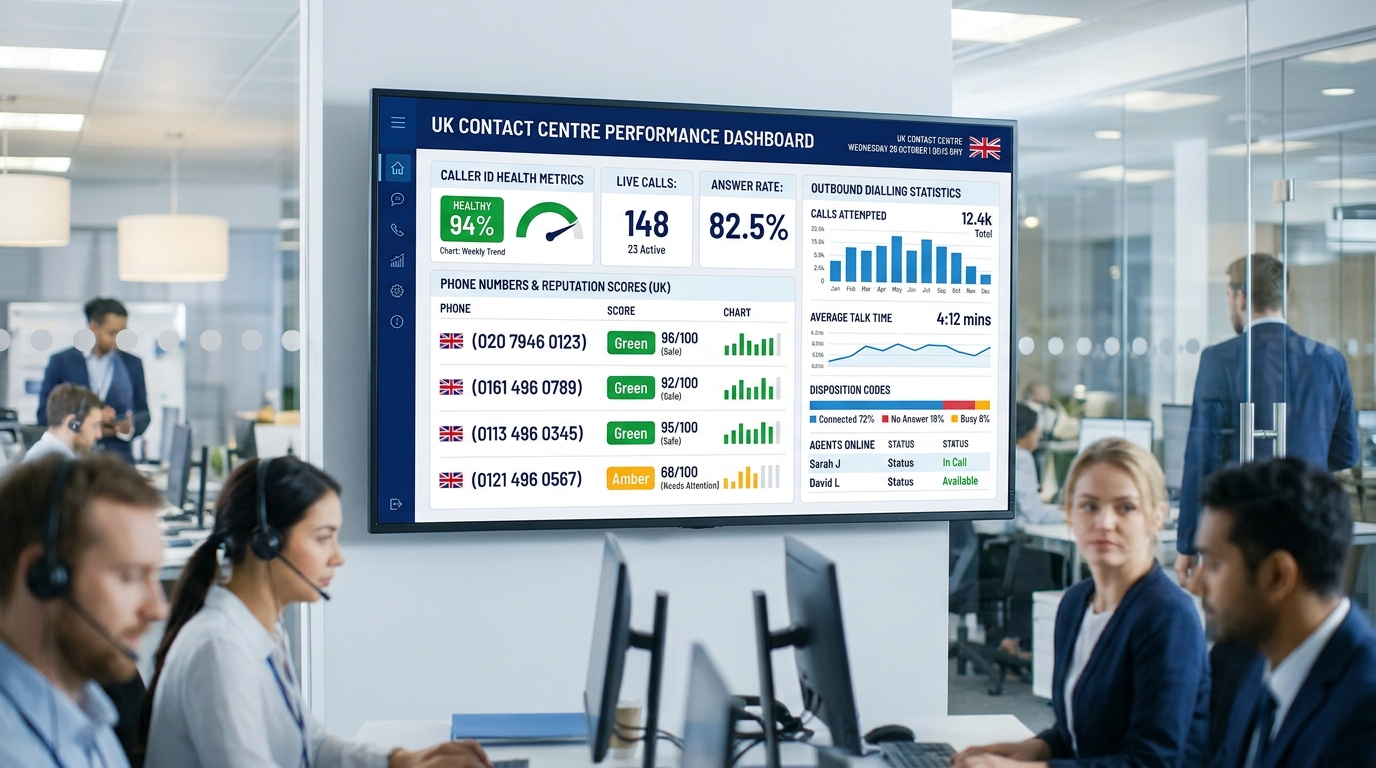
Your number’s reputation degrades before your answer rates drop. By the time you notice fewer connections, apps and networks may already be labelling your DIDs as “Potential Spam” or “Scam Likely” — labels that most recipients never answer. You need visibility into how networks and apps see your calling numbers, not just your own dialler statistics.
Caller ID health comes down to three things. Reputation: how services such as Hiya and Truecaller score the number, based on calling patterns and user reports. Label status: what recipients actually see when the number calls — a business name, “Unknown”, “Spam Risk” or an explicit scam warning. Answer rate trend: a sustained week-on-week drop on one number, when others on the same campaign hold steady, is usually the first sign of reputation damage.
Ask how a platform tracks this: which reputation sources it checks, how often, and what happens when a number is flagged. Does it alert someone and take the number out of rotation, or keep dialling? Hiya also now offers businesses a Caller Reputation report for their own numbers, which is worth checking whatever dialler you use.
Ofcom’s persistent misuse policy looks at how you call, not just whether each call was lawful. Tracking number health gives you the evidence that you are in control — and catches problems while you can still fix them.
5. Calling Behaviour Pattern Management
Reputation systems don’t know your intent. They see observable patterns and user reports. Ring the same person six times in three days and they will report you, and those reports feed the databases that label your numbers. Localised DIDs only help if they are rotated sensibly and not burned out.
Effective calling behaviour management needs four controls working together. Number rotation spreads calls across several DIDs, with a daily ceiling per number, so no single number builds up high-volume flags. Localisation presents a number local to the person you’re calling — Manchester prospects see a Manchester number rather than a London or withheld one. Overcalling prevention limits how often each contact is tried and enforces Ofcom’s rule of no repeat call within 72 hours of an abandoned call unless an agent is guaranteed. Calling hours and pacing keep calls within sensible times and avoid the mechanical bursts that make dialler traffic easy to spot.
Contact-Pro enforces contact-frequency limits per number, calling hours and days per campaign, the 72-hour rule after an abandoned call and the abandoned-call cap per campaign. Preview and manual dialling are available for contacts that need a lighter touch, such as existing customers or sensitive collections work.
Calling behaviour protection isn’t a setting you switch on once. It’s ongoing management that has to adapt as labelling algorithms change.
6. Hiya & Truecaller Registration
Unregistered numbers are judged on calling patterns and user reports alone. Hiya’s caller identification runs on BT and EE, Virgin Media O2 and Samsung Galaxy phones; Truecaller is a widely used app in its own right. Registering through Hiya Connect and Truecaller for Business lets you add your business name — and, where supported, a logo and call reason — so recipients see who is calling before they answer instead of “Unknown Number”.
Registration matters for three reasons. Branded caller ID gives people a reason to pick up. Context for the algorithms: a verified business number is assessed differently from an anonymous one. Fewer wrong labels: legitimate high-volume calling is less likely to be mistaken for spam.
Both services ask you to verify the business and list the numbers you will present. Registration then needs upkeep: newly added DIDs must be registered, and retired numbers removed. Ask any dialler vendor whether they will help register your presented numbers and keep the list current — it’s admin that’s easy to forget and expensive to miss.
Registration isn’t magic. A registered number that behaves like spam — high abandonment, aggressive overcalling, very short calls — will still pick up a bad reputation. Think of registration as the credential that gives your numbers a fair chance; calling behaviour management keeps them clean after that.
Six Questions to Ask Any UK Dialler Vendor
| Feature | What to ask | UK rule or risk |
|---|---|---|
| AMD | What is your reasoned AMD false-positive estimate, and how was it measured? | False positives count towards Ofcom’s 3% abandoned-call limit |
| Call screeners | Do you detect screeners separately from voicemail? What plays if no agent is free? | Ofcom expects an information message, never silence |
| DIDs | How long from order to live number, and who assigns numbers to campaigns? | Presented numbers must be valid, dialable and able to take a return call |
| Caller ID health | Which reputation sources do you check, how often, and what happens when a number is flagged? | Labelled numbers stop being answered long before anyone complains |
| Calling behaviour | Can I cap attempts per contact and calls per number, and set calling hours per campaign? | No repeat call within 72 hours of an abandoned call without a guaranteed agent |
| Hiya & Truecaller | Will you help register our numbers and keep the registration current? | Unregistered numbers are judged on patterns and reports alone |
The Six Features as a System
These six capabilities work as a system, not a checklist. Low AMD false positives reduce abandoned calls, but only if someone is watching number health before answer rates collapse. DID rotation protects individual numbers, but only if those numbers are registered with Hiya and Truecaller in the first place. UK outbound calling in 2026 needs a platform that brings compliance, reputation management and sensible automation together — not just predictive dialling with regulatory boxes ticked.
Contact-Pro is built for UK outbound: Ofcom’s abandoned-call rules, TPS/CTPS screening and valid UK caller ID are part of how every campaign runs. To see how it handles the six areas above with your own campaigns, talk to our team.
Subscribe to newsletter
Want to learn more about how we can help your business grow?
Related Articles
Delve into a rich tapestry of knowledge and inspiration in our blog section. Unleash the potential of your coding journey as we explore industry trends.