Awaab's Law and remote video inspections: meeting the 10-day and 3-day deadlines
By Chris Key, Hostcomm. Last reviewed 12 September 2026.
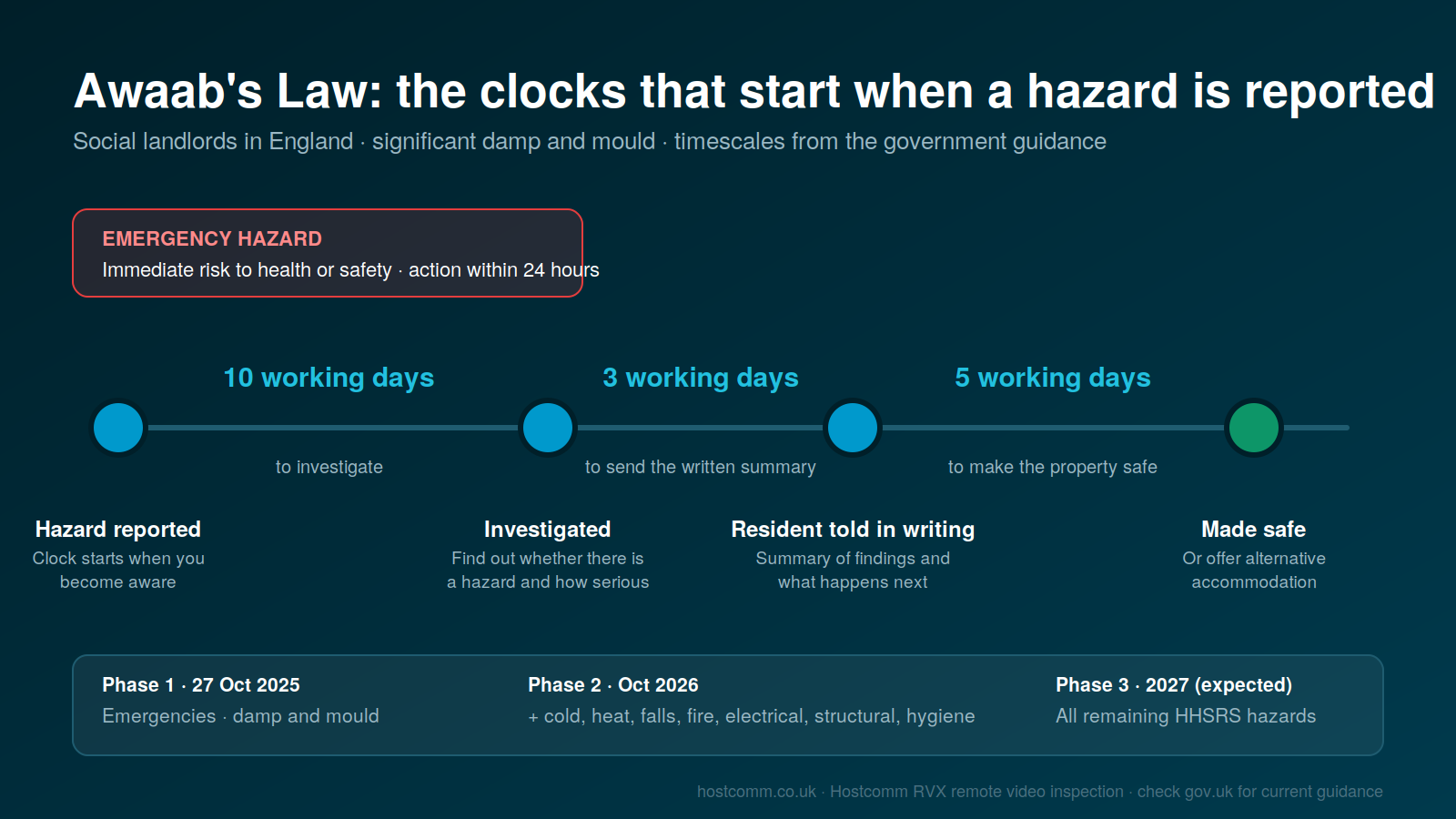
Awaab's Law requires social landlords in England to investigate reported damp and mould within 10 working days, give the resident a written summary of findings within 3 working days of the investigation, make significant hazards safe within 5 working days of that, and attend emergency hazards within 24 hours. Remote video inspection lets a repairs team meet the investigation and written-summary deadlines the same day a hazard is reported, and reserves surveyor visits for the cases that need one.
What Awaab’s Law actually requires
Awaab’s Law is the name given to the provisions of the Social Housing (Regulation) Act 2023 that put fixed timescales on how social landlords respond to hazards in their homes. It is named after Awaab Ishak, who died in December 2020 aged two from prolonged exposure to mould in his family’s housing association flat in Rochdale, after repeated complaints had gone unactioned.
It is being introduced in phases:
| Phase | In force | Covers |
|---|---|---|
| 1 | 27 October 2025 | Emergency hazards; significant damp and mould |
| 2 | October 2026 | Adds excess cold and heat, falls, structural collapse, fire, electrical and hygiene hazards |
| 3 | 2027 (expected) | All remaining HHSRS hazards except overcrowding |
The private rented sector is not yet covered. The Renters’ Rights Act contains the power to extend Awaab’s Law to private landlords; on current expectations that will not be before 2027.
The core timescales for a significant damp and mould hazard are:
| Step | Deadline |
|---|---|
| Investigate a reported hazard | Within 10 working days of becoming aware |
| Give the resident a written summary of findings | Within 3 working days of the investigation |
| Make the property safe (where the hazard is significant) | Within 5 working days of the investigation |
| Emergency hazard (immediate risk to health or safety) | Action within 24 hours |
| If the home cannot be made safe in time | Offer suitable alternative accommodation at the landlord’s expense |
Landlords must also keep records of their attempts to comply, including all correspondence with the resident and any contractors, and should take into account circumstances that raise the risk — young children, older people, and anyone with a health condition such as asthma. These timescales are as set out in the government guidance for social landlords; always check the current version.
Why the timescales are harder than they look
The clock starts when the landlord becomes aware — a phone call, an email, a portal report, or a note from a contractor. Ten working days sounds generous until you map it against a typical repairs process:
- Days 1–2: the report is logged and categorised by a contact-centre advisor who cannot see the problem.
- Days 3–8: the case waits for an inspection slot. Surveyors are scarce; residents work; access is missed.
- Day 9: the surveyor attends, takes photos, and writes up.
- Day 10–13: the written summary is drafted, approved and sent — inside the 3-day window only if nothing slips.
Every day the advisor spends unable to see the hazard is a day taken from the surveyor. And a mis-categorised report — mould logged as “condensation, advise resident” — may never start the clock at all until the resident complains again, by which time the landlord has been “aware” for weeks.
What a remote video inspection changes
Remote visual assistance means the advisor sees the hazard through the resident’s own phone, during the first contact, and the evidence is captured to the case.
Same-day investigation. The advisor texts a link. The resident opens it in their phone browser — no app — and points the camera. The advisor guides them with a live pointer, switches on the torch, zooms, and captures photos and video. A damp report is investigated on day one, not day nine.
Structured evidence. A guided self-survey walks the resident through exactly what a surveyor would look for: the whole wall, a close-up, the window and any condensation, the extractor fan, whether there is a leak, how long it has been happening, and whether anyone in the home has a respiratory condition. Yes/no answers branch so residents only see the questions that apply. Photos are checked as they are taken and the resident is asked to retry if the shot is too dark or doesn’t show what was asked.
The written summary, on time. Because the photos, answers and readings are already on the case, the written summary for the resident can be produced the same day: a plain-English statement of what was found and what happens next, followed by the evidence. Hostcomm RVX generates this as a PDF report with the summary on the first page.
Records of compliance. Every invitation, reminder, photo, answer and report is timestamped against the case — the record of “attempts to comply” and “correspondence with the resident” the guidance asks for.
Surveyors where surveyors are needed. Video triage doesn’t replace a qualified assessment for hazards that need one. It ensures the surveyor’s diary goes to those cases, with the evidence already on file, and that the cases that can be resolved or made safe without a visit are handled in hours.
Subscribe to newsletter
Want to learn more about how we can help your business grow?
Related Articles
Delve into a rich tapestry of knowledge and inspiration in our blog section. Unleash the potential of your coding journey as we explore industry trends.