How Does Automated Voicemail Detection Work? AMD, Call Screening & Spam Flagging Explained (2025)
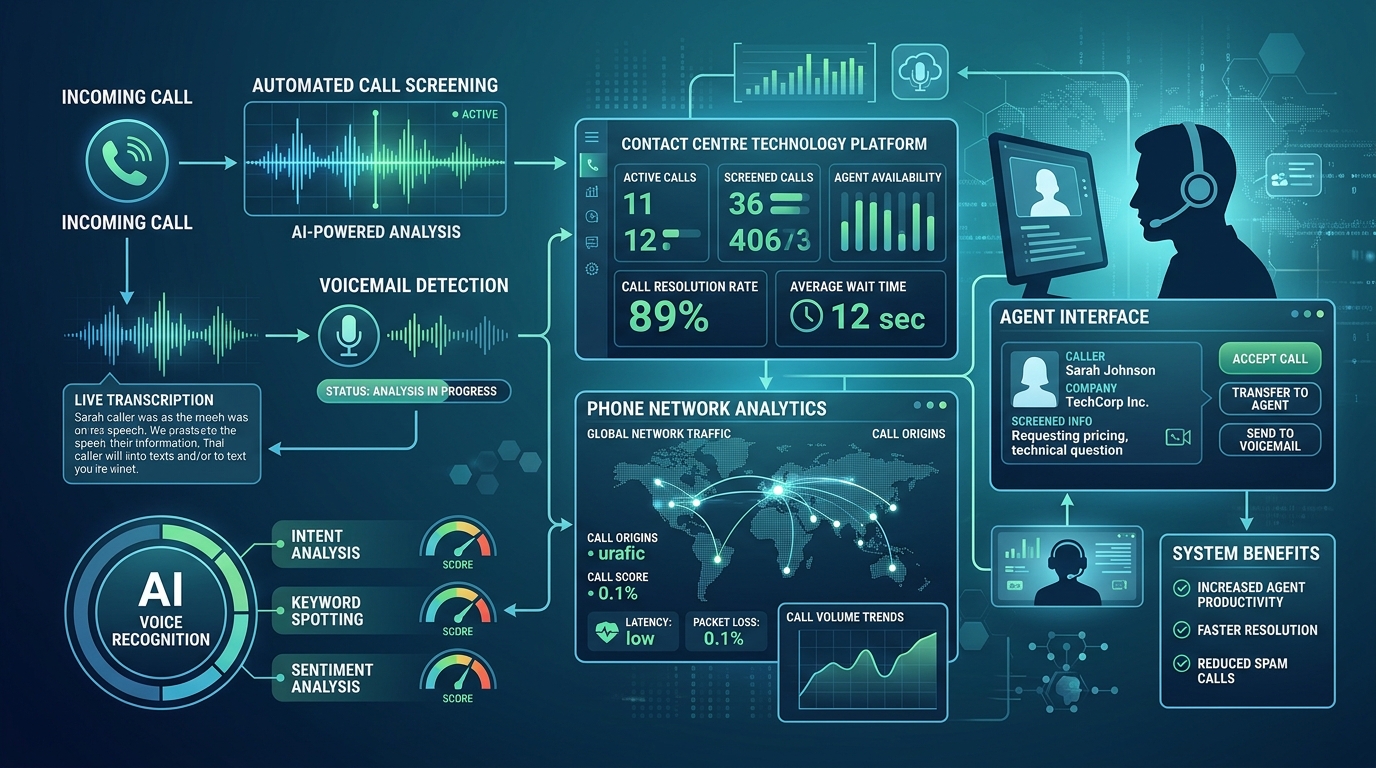
Automated Voicemail Detection (AMD) analyses the first 1–2 seconds of an answered call to determine whether a human or machine picked up. Modern AI-powered AMD reaches 95–99% accuracy by detecting speech patterns, silence gaps and voicemail tones, allowing outbound systems to route live conversations to agents while automatically handling voicemail. Today's challenge: carrier-level call screeners now intercept calls before traditional AMD even fires.
What Is Answering Machine Detection?
Answering machine detection is dialler technology that listens to the opening moments of an answered call and makes a snap judgement: human or machine. When a predictive or progressive dialler places an outbound call and the line connects, AMD analyses audio patterns, silence durations and speech cadence to classify who or what answered. If a human is detected, the call connects to an available agent. If a machine is detected, the system either disconnects, leaves a pre-recorded voicemail drop, or queues the number for callback.
The economics are straightforward. Roughly 80% of cold calls now go to voicemail, so optimising AMD and voicemail handling is one of the biggest levers available to improve agent productivity and connect rates. With manual dialling, agents spend 40+ minutes per hour listening to rings, voicemails and busy signals — only 15–20 minutes actually talking. AMD filters out the machines, keeping agents in back-to-back live conversations for 45+ minutes per hour.
How AMD Detection Methods Actually Work
At its core, AMD extracts features from the opening seconds of audio and runs a model that returns a probability of 'human' versus 'machine'. The dialler then applies a threshold and routes the outcome. The difference between legacy and modern AMD is machine learning: newer systems recognise thousands of greeting variations across carriers, languages and devices, while older rule-based approaches relied on rigid heuristics that frequently misclassified calls.
| Detection Method | How It Works | Detection Speed | Accuracy (%) | False Positive Rate |
|---|---|---|---|---|
| Tone-Based Detection | Listens for the 'beep' after a voicemail greeting, confirming the call reached a machine | 2–4 seconds | 60–70% | High (15–20%) |
| Silence-Based Detection | Analyses silence gaps: humans pause after "Hello?"; machines deliver continuous greetings | 3–5 seconds | 70–75% | Moderate (10–15%) |
| Keyword Matching | Detects phrases like "leave a message" or "missed your call" in live transcription | 2–3 seconds | 75–85% | Moderate (8–12%) |
| AI/ML Voice-Print Analysis | Machine learning models analyse audio spectrograms and speech patterns to classify human vs machine | 1–2 seconds | 95–99% | Low (<5%) |
False positives — when AMD misclassifies a live human as a machine and disconnects — are the scarier of the two failure modes. One AMD vendor estimates that a 10-agent call centre loses £18,000 per month to false positives. False negatives (letting machines reach agents) waste time, but false positives torch qualified prospects. For high-value B2B deals, most teams should bias toward protecting live humans; a few extra voicemails reaching agents is cheaper than hanging up on a decision-maker.
The New Layer: Carrier-Level Call Screening vs Traditional AMD
Here's the problem nobody on the vendor pages mentions: carrier-level call screeners now intercept traffic before traditional AMD even fires. Google Call Screen, Apple's Silence Unknown Callers, Verizon Call Filter and similar tools sit at the network or device layer, screening incoming calls based on spam labelling, STIR/SHAKEN attestation and user-configured rules. When a recipient has enabled call screening, your outbound call never reaches their voicemail greeting — it hits a carrier-controlled gatekeeper first.
Google's Pixel Call Assist, for instance, answers suspected spam calls with an AI-powered screening flow that asks who's calling and why. The recipient sees a real-time transcript of the caller's response and can decide whether to pick up, decline or ask for more information. Since Call Assist already answered the call, declining it doesn't send it to voicemail — the call simply ends. Your AMD never gets a chance to classify the outcome, because the call was terminated at the carrier layer.
Apple's Silence Unknown Callers feature (available in iOS 13 and later) takes a different approach: any call from a number not in Contacts, recent outgoing calls or Siri Suggestions goes straight to voicemail without ringing the device. In iOS 26, Apple introduced full call screening similar to Google's: unknown callers are answered by an automated message asking for their name and reason for calling, with the response transcribed to text. If the recipient declines, the call ends — no voicemail, no AMD classification.
STIR/SHAKEN (Secure Telephone Identity Revisited / Signature-based Handling of Asserted information using toKENs) is a caller ID authentication framework mandated by the FCC for major U.S. voice providers as of 2021, with similar frameworks rolling out in the UK and EU. It lets carriers verify that a call is actually coming from the phone number displayed on the recipient's screen, making it harder for scammers to spoof legitimate numbers. When a call originates, the originating carrier digitally signs the caller ID information. The receiving carrier validates that signature before the call reaches the recipient.
STIR/SHAKEN doesn't stop spam calls outright — it confirms the number wasn't spoofed during transmission. But that confirmation directly affects whether carrier-level call screeners label your traffic as "Verified Call", "Spam Likely" or "Scam Likely". A verified call is more likely to ring through; an unverified or poorly-attested call gets screened, blocked or sent to voicemail before your AMD can classify it. The practical upshot: outbound contact centres need both clean STIR/SHAKEN attestation (to reach the recipient) and accurate AMD (to handle the calls that connect).
How Contact-Pro AMD + Persona AI Handle Both Layers
Hostcomm's Contact-Pro predictive dialler includes AI-powered AMD that analyses every answered call in under 2 seconds, reaching 95%+ accuracy in live UK and U.S. carrier environments. When combined with Persona AI voice agents, the system handles the full workflow: carrier-layer attestation, AMD classification, compliant voicemail drops and seamless live-connect handoffs. Here's the step-by-step:
- STIR/SHAKEN attestation: Contact-Pro routes outbound calls through carriers that sign traffic with full attestation, reducing spam flagging at the carrier layer. Calls display as "Verified" or "Caller Verified" on recipient devices, improving answer rates.
- Call connects: When a call connects, Contact-Pro's AI-powered AMD analyses the first 1–2 seconds of audio, extracting speech patterns, silence gaps and voicemail tones.
- Human detected: If AMD classifies the call as human-answered, Contact-Pro routes it to an available agent (for human-staffed campaigns) or to a Persona AI voice agent (for fully automated outreach). The handoff occurs within 200 milliseconds, so the recipient hears a live greeting immediately after saying "Hello?".
- Machine detected: If AMD detects a voicemail greeting, Contact-Pro triggers one of three behaviours (campaign-configurable): (a) disconnect and queue for callback, (b) play a pre-recorded voicemail drop message, or (c) pass the call to Persona AI to leave a natural, conversational voicemail that adapts to the greeting length and waits for the beep.
- Compliant message-drop: For regulated campaigns (collections, telemarketing, political), Contact-Pro enforces TCPA and Ofcom voicemail-drop rules: the message must identify the caller, state the purpose and provide an opt-out method. Persona AI can deliver these disclosures in natural speech, avoiding the robotic cadence that flags voicemails as spam.
- False-positive recovery: If AMD misclassifies a live human as a machine (false positive), the recipient hears the start of the voicemail-drop message. Contact-Pro monitors for mid-message responses ("Hello? Who is this?") and can interrupt the drop to connect the call to an agent or AI, recovering the lead.
The key difference from standalone AMD solutions: Persona AI handles both the voicemail-drop and the live conversation using the same voice model, so the recipient experience is consistent whether they answer live or call back after hearing the voicemail. This matters for brand-sensitive outreach where a clumsy voicemail can cost you the account, not just the call.
AMD Accuracy Benchmarks: What the Numbers Actually Mean
Vendor-published accuracy percentages are unaudited, so treat them as claims rather than facts. That said, the step-change from legacy to AI-driven AMD is measurable. Traditional rule-based AMD (tone detection, silence detection, keyword matching) tops out around 60–75% accuracy in real conditions. Modern AI-powered AMD, using machine learning models trained on hundreds of thousands of call recordings, reaches 95–99% accuracy under strong conditions. Twilio's AMD documentation is refreshingly honest: "Since not all humans and not all voicemail greetings follow similar patterns, it's possible that AMD will not always return the right answer."
Detection speed has also improved. Legacy AMD systems took 3–5 seconds to analyse a call, introducing noticeable dead air that recipients interpreted as a "ghost call" — silence followed by disconnection. Modern AI-powered AMD classifies calls in 1–2 seconds, and some vendors (Platform28, for example) claim sub-1-second detection. Faster detection reduces dead air, which directly affects whether your number gets flagged as spam.
False-positive rates (hanging up on live humans) have dropped from 15–20% with legacy systems to under 5% with AI-powered AMD, and some vendors claim sub-1% false positives. That improvement is the reason AMD is usable at scale for modern outbound sales and collections agencies. Five9, NICE CXone, Twilio and Genesys all offer AMD as a standard feature in their cloud contact centre platforms, with configurable detection thresholds to balance speed and accuracy based on campaign needs.
FAQ: Answering Machine Detection & Call Screening
What is answering machine detection?
Answering machine detection (AMD) is dialler technology that analyses the first 1–2 seconds of an answered call to determine whether a human or an answering machine picked up. It detects speech patterns, silence gaps and voicemail tones, then routes live answers to agents and machines to voicemail-drop or callback queues. Modern AI-powered AMD reaches 95–99% accuracy, compared to 60–75% for legacy rule-based systems.
How fast is AMD?
Modern AI-powered AMD classifies calls in 1–2 seconds. Legacy rule-based systems took 3–5 seconds, introducing noticeable dead air that recipients interpreted as "ghost calls". Faster detection reduces the delay between a recipient saying "Hello?" and hearing a live agent or voicemail-drop message, which directly affects spam flagging rates and answer rates.
Can AMD bypass spam flagging?
No. AMD operates after a call connects; spam flagging happens before the call rings. Carrier-level call screeners (Google Call Screen, Apple Silence Unknown Callers, Verizon Call Filter) intercept calls based on STIR/SHAKEN attestation, spam labelling and user-configured rules. If your call is flagged as "Spam Likely", it may never connect, so AMD never runs. You need STIR/SHAKEN attestation to avoid spam labels, and AMD to handle the calls that do connect.
What happens when AMD detects voicemail?
When AMD detects a voicemail greeting, the dialler triggers one of three behaviours (campaign-configurable): (1) disconnect and queue the number for callback, (2) play a pre-recorded voicemail drop message, or (3) pass the call to an AI voice agent to leave a natural, conversational voicemail. For regulated campaigns (TCPA, Ofcom, PECR), the voicemail drop must identify the caller, state the purpose and provide an opt-out method.
Is AMD compliant with TCPA/PECR/Ofcom rules?
AMD itself is compliant, but how you use it determines regulatory risk. Under the U.S. Telephone Consumer Protection Act (TCPA), predictive diallers must not abandon more than 3% of answered calls per campaign per 30-day period. AMD inaccuracy eats into that 3% budget: if your false-positive rate is high, you're dropping live humans, which counts as an abandoned call. Under Ofcom rules (UK), if a call connects but doesn't reach an agent within 2 seconds, you must play a pre-recorded message identifying the caller. AMD's dead-air window can trigger this requirement if detection is slow.
Do Contact-Pro and Persona AI include AMD at no extra charge?
Yes. AI-powered AMD and compliant voicemail-drop are included in Contact-Pro's per-seat pricing (from £35/user/month) with no per-minute AMD surcharge. Some vendors charge per minute for AMD (e.g. Twilio, Retell AI), which can add up quickly on high-voicemail campaigns. Contact-Pro's flat per-seat pricing makes AMD cost predictable, even on campaigns where 80% of calls hit voicemail.
Subscribe to newsletter
Want to learn more about how we can help your business grow?
Related Articles
Delve into a rich tapestry of knowledge and inspiration in our blog section. Unleash the potential of your coding journey as we explore industry trends.