How to Automate Inbound Customer Service Calls with AI Voice Agents and CRM Integration (2025 Guide)
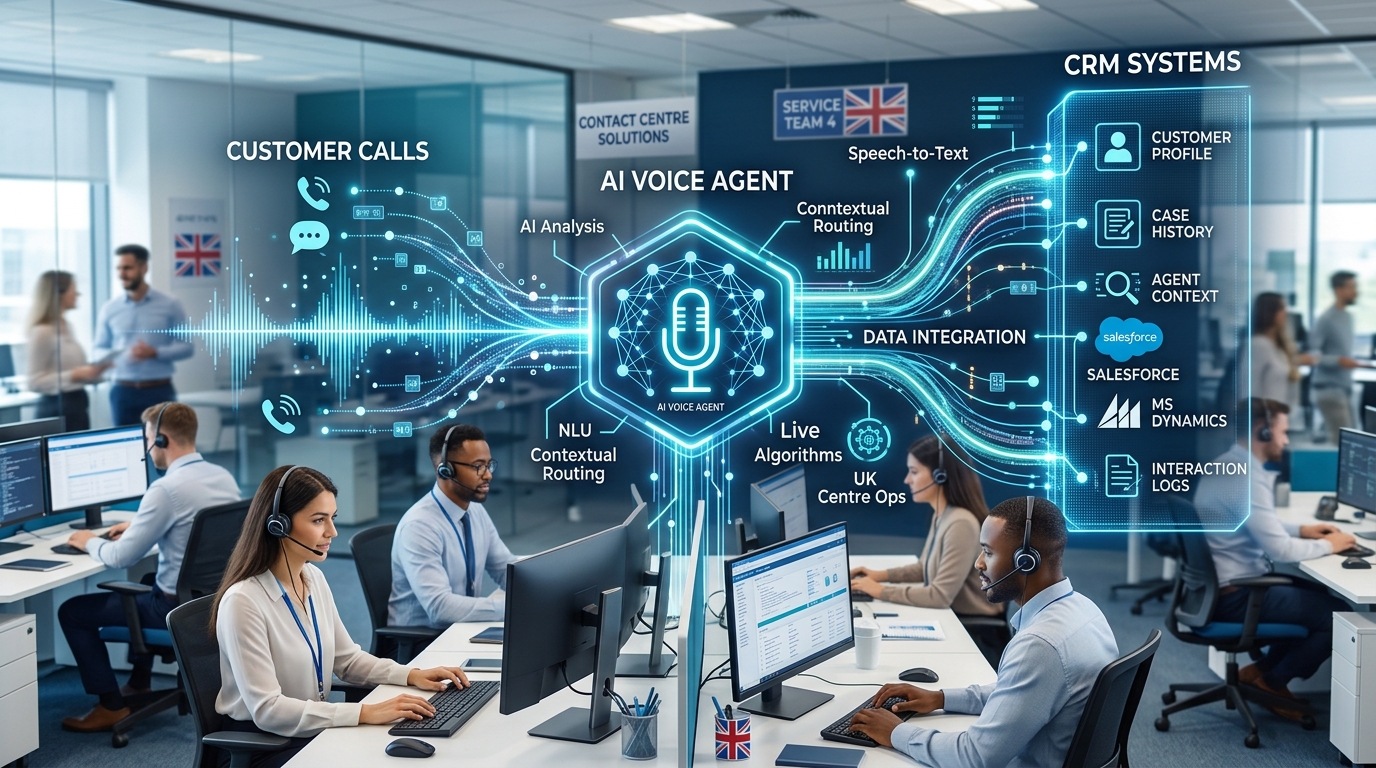
An AI voice agent is software that conducts natural conversations with callers using speech recognition and text-to-speech technology. When integrated with your CRM, the agent automatically retrieves customer data during calls, logs interaction details, and updates records in real time — eliminating manual data entry whilst maintaining full conversation context across your support team.
Why Traditional IVR Fails the CRM Integration Test
Most contact centres run legacy interactive voice response (IVR) systems that can route calls and play pre-recorded menus, but cannot actually converse with customers or write back to your CRM. When a caller rings about a delayed order, the IVR can't look up that order in Salesforce, confirm the tracking number, or log the inquiry. Your agent still has to ask "what's your account number?" even though the customer entered it thirty seconds ago.
AI voice agents close that gap. Modern conversational AI platforms — such as Hostcomm's Persona AI — combine automatic speech recognition (ASR), natural language understanding (NLU), and bi-directional API connections to CRM systems. The agent answers the call, identifies the customer by CLI or account number, pulls their record from the CRM, resolves the query in natural language, then writes a timestamped interaction summary straight back into the CRM case history.
How AI Voice Agents Connect to Your CRM: API vs Native Integrations
There are two main methods for linking AI voice platforms to customer relationship management systems, and the right choice depends on your CRM, IT resources, and update frequency.
REST API Integrations (Universal, Flexible)
Most enterprise CRMs — including Salesforce, Microsoft Dynamics 365, HubSpot, and Zoho — expose REST APIs that allow external applications to query and update records securely. An AI voice agent connects via these APIs using OAuth tokens or API keys. During a call, the platform issues HTTP requests to fetch account details, check case history, or create a new support ticket. This approach works with any CRM that offers an API, supports custom fields and workflows, and gives you control over exactly which data the voice agent can access.
The trade-off: API integrations require initial configuration — defining endpoints, field mappings, authentication scopes, and error-handling logic. Larger deployments often involve middleware (such as MuleSoft or Zapier) to orchestrate calls between the voice platform and multiple back-end systems.
Native Connectors (Faster Setup, Limited Scope)
Some AI voice platforms offer pre-built connectors for popular CRMs. These plug-ins handle authentication, common field mappings, and basic CRUD operations (create, read, update, delete) out of the box, reducing deployment time from weeks to days. Hostcomm Persona AI, for example, includes tested connectors for Salesforce Service Cloud and Zoho Desk, enabling contact centres to go live without writing a single line of integration code.
The limitation: native connectors typically support a fixed set of objects and fields. If your organisation uses custom CRM modules or complex approval workflows, you may still need API-level access for advanced use cases.
Hybrid Approach (Best of Both)
Many deployments start with a native connector for standard enquiries — checking account status, logging call outcomes — then layer on custom API calls for specialised workflows such as payment processing, fraud escalation, or multi-system lookups that span CRM, ERP, and billing platforms.
The Call Flow: Intake to Resolution (or Handoff)
Understanding the end-to-end architecture helps IT and contact centre leaders plan capacity, security, and failover. Here's how a typical inbound call flows through an AI voice agent integrated with CRM and live agent systems.
- Call Intake: Customer dials the support line. The telephony platform (SIP trunk, cloud telephony, or existing PBX) routes the call to the AI voice agent endpoint.
- Caller Identification: The agent captures CLI (calling line identity) or prompts for an account number, then queries the CRM API to retrieve the customer record — name, contact history, open cases, subscription tier.
- Intent Detection: Using NLU, the platform identifies what the caller needs: balance enquiry, order status, technical support, billing dispute. Modern agents achieve 85–92% intent accuracy on Tier-1 queries after initial training.
- CRM Lookup/Update: The agent fetches relevant data (last order, outstanding invoice, support ticket status) and presents it conversationally: "I can see your delivery is scheduled for Thursday. Would you like tracking details?" If the customer provides new information — a forwarding address, complaint details — the agent writes it back to the CRM case or contact record in real time.
- Resolution or Handoff: For straightforward requests, the AI resolves the issue autonomously and logs the outcome. For complex or sensitive cases — refunds, technical faults, emotional escalations — the agent performs a warm transfer to a human agent, passing full context (caller identity, issue summary, CRM notes) so the customer doesn't repeat themselves. In Hostcomm deployments, this handoff routes seamlessly to Contact-Pro agents with the CRM screen already populated.
- Post-Call Summary: The platform generates a timestamped transcript, sentiment score, and resolution code, then pushes them to the CRM as an activity or case comment. Supervisors and analytics teams see every AI-handled interaction alongside human-agent calls in a unified reporting dashboard.
Platform Comparison: Hostcomm Persona AI vs the US Giants
Most search results for "AI voice agent CRM integration" surface US-centric platforms — Five9, NICE CXone, Genesys Cloud CX — that offer powerful features but often gloss over UK-specific needs such as GDPR data residency, sterling pricing, and integration with British telephony infrastructure. Here's how they compare on the dimensions that matter for UK contact centres:
| Platform | CRM Integrations Supported | UK Data Hosting | Deployment Time | Human Handoff Method | Indicative Pricing (UK) |
|---|---|---|---|---|---|
| Hostcomm Persona AI | Salesforce, Zoho, HubSpot, Dynamics (API + native connectors) | ✅ London & Manchester data centres | 2–4 weeks | Warm transfer to Contact-Pro with full CRM context | £0.08–0.15/min or seat-based from £60/mo |
| Five9 | Salesforce, Zendesk, ServiceNow (native); others via API | ⚠️ US/EU regions (specify UK on request) | 4–8 weeks | Warm transfer; requires Five9 CCaaS | £100–150/agent/mo (USD converted) |
| NICE CXone | Salesforce, Microsoft Dynamics, custom via API | ⚠️ EU regions; UK hosting at premium tier | 6–12 weeks | Full CCaaS handoff within CXone | £120–180/agent/mo (enterprise licensing) |
| Genesys Cloud CX | Salesforce, Zendesk, Microsoft (AppFoundry integrations) | ⚠️ AWS EU-West (Ireland); UK on request | 8–16 weeks | Genesys native routing | £100–160/agent/mo + integration fees |
| Talkdesk | Salesforce, Zendesk, custom via API | ⚠️ EU regions (Ireland default) | 4–6 weeks | Warm transfer via Talkdesk routing | £90–140/agent/mo |
| 8x8 | Salesforce, Microsoft, NetSuite (limited native support) | ⚠️ EU/US; UK hosting unclear | 6–10 weeks | Internal IVR handoff | £85–130/agent/mo |
Key insight: US-headquartered platforms often require enterprise licensing, lengthy professional-services engagements, and impose data-residency surcharges for UK hosting. Hostcomm Persona AI is purpose-built for UK contact centres, with native sterling pricing, London-region data sovereignty, and a faster go-live cycle because you're not customising a global CCaaS behemoth — you're deploying a focused AI voice layer that integrates with your existing telephony and CRM stack.
Subscribe to newsletter
Want to learn more about how we can help your business grow?
Related Articles
Delve into a rich tapestry of knowledge and inspiration in our blog section. Unleash the potential of your coding journey as we explore industry trends.