How to Replace IVR with a Conversational AI Voice Agent: A UK Contact Centre Migration Guide
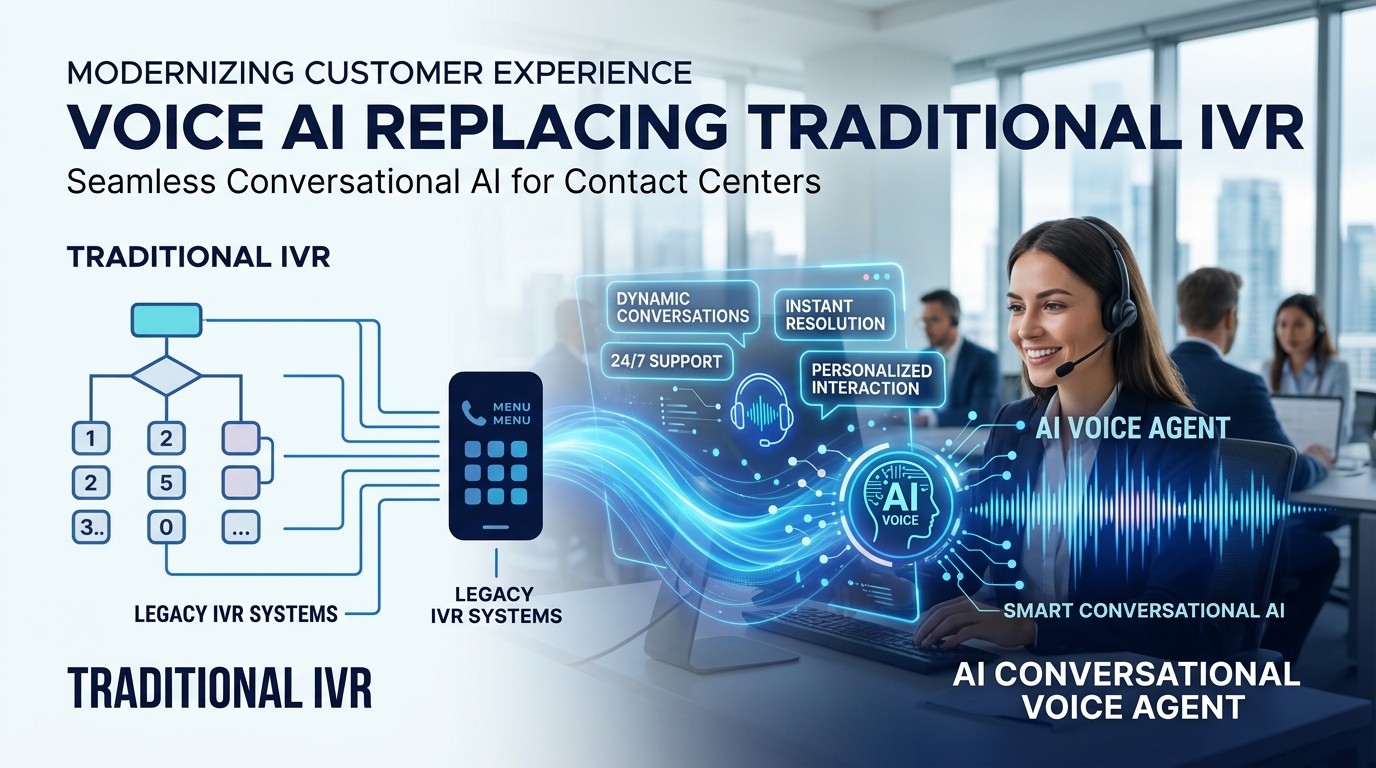
Replacing IVR with a conversational AI voice agent means swapping menu-driven phone trees for natural language interactions that understand caller intent and resolve issues through dialogue rather than button presses. UK contact centres making this shift report containment rate improvements from 15% (traditional IVR) to 70-80% (AI voice agents), according to 2026 Bluejay industry data, with cost-per-call reductions of 90-95%.
Why Traditional IVR Is Failing UK Contact Centres
Traditional IVR systems force callers into rigid menu structures that drive abandonment. Brightmetrics research (2025) shows UK call centre abandonment rates have climbed from 5.4% in 2018 to 8.9% in 2024, with IVR abandonment averaging 15% across industries. The numbers are worse than they look: Call Centre Helper reports that mobile phone companies, who rely heavily on IVR, see significantly higher abandonment—callers simply hang up when forced through multi-level menus.
The problem isn't just frustration. Every abandoned call represents lost revenue, repeat contact costs, and damaged customer relationships. Meanwhile, conversational AI voice agents handle the same volume with 70-80% containment rates—meaning seven or eight out of ten callers get their issue resolved without needing a human agent.
Traditional IVR vs Conversational AI: A Direct Comparison
| Metric | Traditional IVR | Basic Conversational IVR | Full Conversational AI Voice Agent (Hostcomm Persona) |
|---|---|---|---|
| Containment Rate | 15-30% | 40-55% | 70-80% |
| Setup Time | 8-12 weeks | 6-8 weeks | 2-4 weeks with Hostcomm Contact-Pro integration |
| Cost Per Call | £4.50-£9.00 (including agent escalation) | £2.50-£5.00 | £0.25-£0.40 (automated), £0 infrastructure scaling |
| Integration Effort | High (custom telephony/CRM work) | Medium (API + training) | Low (native Contact-Pro dialler + CRM connectors) |
| Languages Supported | 2-3 (recorded prompts) | 5-10 (TTS-based) | 40+ (real-time multilingual NLP) |
| Caller Frustration | High (menu navigation, no intent recognition) | Medium (basic NLP, limited context) | Low (natural conversation, context retention) |
| UK Compliance (GDPR, PCI-DSS, Ofcom) | Manual audit required | Partial (depends on vendor) | Native UK hosting, full audit trail, Ofcom call-handling compliance built-in |
Sources: Naitive AI (January 2026), Decagon AI industry benchmarks, Hostcomm Persona deployment data (2025-2026).
The Five-Step IVR-to-AI Migration Framework
This is the structured approach UK contact centres use to replace IVR systems without service disruption. Each step builds on the previous one, and the entire process typically runs 8-12 weeks from audit to full cutover.
Step 1: Audit Your Existing IVR Flows
Map every menu option, call path, and escalation point in your current IVR. Most legacy systems have 8-15 menu levels with dozens of dead-ends—paths that force callers to hang up or start over. Document:
- Call volume by menu option (which paths handle the most traffic?)
- Abandonment points (where do callers give up?)
- Average time in IVR before reaching an agent
- Percentage of calls that loop back or require multiple attempts
If your telephony platform exports call logs, analyse 30 days of data. If not, manually track 200-300 calls. The goal is to identify the 20% of call reasons that drive 80% of volume—these are your automation candidates.
Step 2: Map IVR Paths to AI Intents
Convert menu-driven logic into natural language intents. For example, the IVR path "Press 1 for orders, then press 2 for order status" becomes the intent "Check my order status" with variations like "Where's my delivery?", "Track my parcel", "Order hasn't arrived".
Start with 15-20 core intents covering your highest-volume call reasons. Hostcomm Persona's intent library includes pre-built UK contact centre intents (billing inquiries, appointment booking, service faults, account updates) that you can adapt rather than build from scratch.
For each intent, define:
- Required data points (order number, account ID, postcode)
- Backend system lookup (CRM, order management, billing platform)
- Success criteria (what does "resolved" look like?)
Step 3: Integrate with Contact-Pro Dialler and CRM
Hostcomm's Contact-Pro predictive dialler already connects to your CRM and telephony infrastructure. The AI voice agent (Persona) sits in front of Contact-Pro, handling inbound calls and routing unresolved interactions to the right agent with full context.
Technical integration checklist:
- API access to your CRM (Salesforce, Microsoft Dynamics, Zendesk, Freshdesk)
- Real-time data lookup (sub-200ms response time for caller authentication and data retrieval)
- Call recording and compliance logging (required for FCA, PCI-DSS, Ofcom)
- Warm transfer protocol (AI passes conversation history + intent confidence to agent)
Most UK deployments take 2-3 weeks for full integration, including testing and compliance sign-off.
Subscribe to newsletter
Want to learn more about how we can help your business grow?
Related Articles
Delve into a rich tapestry of knowledge and inspiration in our blog section. Unleash the potential of your coding journey as we explore industry trends.